Showing posts with label RTC10. Show all posts

Sunday, 22 February 2015

Ideas for group work in the high school classroom: Wāhanga Rua

Part Two:

I am ready to roll out my groups tomorrow! I feel I know the students well enough and have enough data to group them appropriately. I have decided I will need to review these groups over the rest of the term. I will be satisfied if they are fully established by the start of Term 2.Here is the written instruction I will provide students tomorrow, after I have told them their groups.


Groups groups groups!

Your first project as a group!

1. Choose an abstract noun that will be a goal for your group to work on. You need to find out the English, Maori and any other relevant translations of the word. I will discuss this with your group over the coming week and will help you decide. Think of this as your core value, like Trident's core values of manaakitanga, kia manawa nui and whaia te iti kahurangi. Once you have made your selections Ohinemataroa [our hapu] will potentially have TWENTY core values to strive to fulfill!!

Then either:

2. Suggest a 'patron' of your group. Think Harry Potter and patronuses except different. They must be: a New Zealander and creating the kind of thing we might study in English. So they could be a lyricist, director, author, actor, illustrator... Again, I will help you choose. Our hapu's patron will be Lorde.

OR:

3. Design a flag or sigil for you whanau. Remember that your whanau has up to 30 members across four different classes. How can you best represent those 30 people? Hint: perhaps you could ask me what your other group members have chosen as their core value.

I will be there to help with all of this - it's not a test!


I have also created a poster that will be on my door and probably on the whiteboard. And duh, on my computer's desktop! So the kids will now see this whenever there's no Power Point, video, etc on my projector screen. I'm a genius.


I can take no credit for the creation of the poster. I used the website Canva, literally didn't choose the fonts, found the image on Google Image Search and that's about it. The only thing I came up with was splitting into five. So I'm hoping one of my more artistic students decides to create a more snazzy poster for our hapu. Visual and verbal text credits? Yes please!

I'm sure you can gather from the poster that I have chosen my hapu name as well as the five whanau. Ohinemataroa is the proper Maori name for Whakatane River, and the other five are the surrounding rivers from this region. Some words are supposed to have macrons but unfortunately this font wouldn't recognise the macron-ed symbols.

I'm a little nervous about how the roll out will go, but I think I'll have enough buy in to make it work.

You may have seen my creative writing starters posts and be wondering what that's all about. I plan to talk about them in my next post or so. Suffice to say, my participation in the writing starters seems to be increasing student participation - yay for bribery!


Whāia te iti kahurangi ki te tūohu koe me he maunga teitei
Pursue excellence – should you stumble, let it be to a lofty mountain

Monday, 9 February 2015

Ideas for group work in the high school classroom

Kia ora all! This blog post is a real train of thought, work in progress entry. I have a lot of ideas about using groups in my class and I'm sure this plan will be refined over the coming weeks. I really look forward to hearing your thoughts, suggestions and questions!


I have mentioned before that my department is invigorating our junior program and that these plans are ongoing. A key part of this change is that we are guided by four Kaupapa or themes throughout the year, one in each term. We are starting the year with Papatuanuku and I have explained to the students that we will be considering our texts through this lens.


I have also started the year with my desks in groups for the first time, having never had room before. And that's what this blog post is all about - how I am going to use these groups in the classroom.


Here is the plan:

- I will name the five groups of desks (six desks per group) after a local body of water or landmark: Ohiwa, Rangitaiki, Tarawera, etc. To be confirmed.
- As Trident is our iwi, I will refer to my classroom as a hapu and each group of desks would be a whanau (across classes, for example, there will be at least three groups of students who are "Ohiwa" across at least three different classes)
- each group, in each class, will decide upon an abstract noun that they will aspire to demonstrate. For example aroha, manaakitanga, perseverance... This idea comes from my husband's plan to integrate the qualities of a good teammate into his Sports in Education class.
- somehow, each group of desks will end up with a flag or sigil, a couple of abstract nouns (from the different groups in different classes) and most excitingly, a patron of the arts. Ideally the patron will be a New Zealand author, director, screenwriter, lyricist or actor.


I have two Year 9 classes and a Year 10 class so I'm not sure how to divvy up the research and decision making when it comes to the flags and patrons, but I'm excited about how these decisions can be part of my classroom teaching about visual and verbal texts as well as the context of New Zealand art and literature.


Some decisions I am yet to make are:

- will these groups be flexible? Might I have to jiggle students throughout the year, or is the point to work through any issues with each group by falling back on their core value, as well as my school's core values?
- how will I determine the groups? I will certainly not be splitting them into curriculum levels from lowest to highest. The next obvious choice is to spread each level of ability across each group of desks. Alternatively I could base my decision initially on personality, and subsequently on reshuffling if I notice a predominance of a certain curriculum level at one table. While one of my classes is technically 'streamed' the students do cover a range of two or three curriculum levels, the other two are definitely mixed ability due to their special interest nature (Great Barrier Island group and BYOD class).
- I am also keen to get my seniors to buy into this, but as my Level 1 class is tiny and my Level 2 class is strong willed and very 'cool' I may struggle. They may dismiss the whole thing as very primary school. One strategy might be to not even mention it to them and see if they react to the posters and values going up around the walls.


What do I hope to get out of this?

- accountability, enthusiasm, belonging
- bonding within each group
- I hope that awareness of the other groups who occupy your set of desks will encourage more responsibility as a citizen of the classroom: less graffiti, rubbish and gum under desks.
- More interest in wall displays and therefore other students' work
- behaviour management through positive peer pressure
- more opportunities for peer teaching
- an increase in student progress (hopefully this is the overarching reason why we do anything in the classroom!)


I will see how Term 1 goes and if these ideas are not enough on their own to achieve my goals I may look at introducing some form of inter or intra (or both) group competition. Thankfully we have a fantastic PB4L system of core value certificates and of 'coffee club' stamps that are a simple way to acknowledge and encourage positive behaviour and work ethics. I'm not big on competition in the classroom, but my boisterous junior boys may require that kind of motivation


As you can see I am very excited about how this will work. I'm already thinking about the future and whether I would keep the names the same across the years or whether I could branch out and use different kinds of philosophies, names of novels, international authors, past successful students, the options are limitless...


I would love to hear your ideas, suggestions and advice. Do you use groups in the classroom? Do they stay the same all year? What do kids like or not like about this approach?


Whāia te iti kahurangi ki te tūohu koe me he maunga teitei
Pursue excellence – should you stumble, let it be to a lofty mountain

Wednesday, 23 July 2014

My visit to Te Wharehou o Tuhoe: Te Uru Taumatua

This week I had the pleasure of visiting Te Wharehou o Tuhoe: Te Uru Taumatua, located in Taneatua. The context of the visit was unusual. Our local Rotary branch had organised to have a tour, dinner and a talk delivered by treaty negotiator and New Zealander of the Year finalist Tamati Kruger. Unfortunately Tamati was unable to attend at the last minute, but the warm and articulate Kirsty Luke, General Manager of Te Uru Taumatua, was able to take his place.

I am not a member of Rotary so it was quite strange to be in this ethereal building, with the first non-Tuhoe group of people to use the space.

Kirsty took us on a tour of the facilities and explained the decision making behind many aspects of the building. The images below, from the Tuhoe website, outline the iwi's thought process behind the building. We got to see the small library and archive space, cafe (which opens next month), office space, work areas available for use by the public and the main function space at the front of the building. The whare is striking with timber used throughout, always sourced from within a 100 kilometre radius. Te Wharehou is a 'living building' and it was apparent from our visit that this has just as much to do with the people as it does the materials used. Pride and mana radiated with every word Kirsty spoke about her surroundings.

Following dinner, Kirsty spoke about the past, present and future - no mean feat! She acknowledged the timing of our visit, given that this week is the signing of Tuhoe's treaty settlement, as well the Police Commissioner's visit to Ruatoki to apologise for the treatment of members of the public, including children, during the Ruatoki raids of 2007. (It only took 174 and 7 years...) Before visiting the whare I assumed this building was purely for Tuhoe use, but Kirsty took the opportunity to emphasise that it has been built to be used for the good of everyone in the area from knitting groups to youth groups. That's when I started to think about my students and how we could benefit from this wonderful space. The biggest impression I left with was the emphasis Kirsty placed on raising a new generation of positive and optimistic Tuhoe.


So, why am I writing about this? Firstly, many students at my school are Tuhoe and I feel I know a lot more about the history of this area after visiting Te Wharehou. Tuhoe are often assumed to be proud, stand-offish and radical. Like with any group of people, it doesn't help to buy into such assumptions. After hearing Kirsty speak, I would not describe her as proud, stand-offish and radical but passionate about Te Urewera, warm and aspirational.
The second reason I am writing about this experience here is to encourage teachers to engage in their students' wider world. We hear this kind of thing a lot, and often it is a challenge to make the time, especially when you are not involved in sport. I know feel like I have made a connection and I am thinking about how I can utilise Te Wharehou o Tuhoe for my students next year. I said 'yes' to this dinner on a whim, not really knowing what it would be all about, and it has turned into a hugely valuable experience for myself and my fellow colleagues who attended. One is a graphics teacher and will now take students to Taneatua so that they can discuss the design of the building. Another runs Gateway and has already contacted Kirsty about a work placement for one of our Y13 students. A third is a Social Studies teacher from another school who intends to re-write a unit that involves looking at Te Wharehou. He would also like to see departments from all around the area create a cross-curricular range of programs that Tuhoe could use with visiting classes. There is the maths in quantity surveying, art in the sculpture, drama to be done in the amphitheater, science in the water treatment facility...

What are some surprising ways that you have connected with your students' world?


 Whāia te iti kahurangi ki te tūohu koe me he maunga teitei
Pursue excellence – should you stumble, let it be to a lofty mountain

Sunday, 6 July 2014

Teacher-only day reflections

Teacher-only day: Friday the 4th of July, 2014


Managing social media
Tatiako: where to from here?
Registered teacher criteria
Special interest groups: cross-curricular learning, authentic learning contexts, BYOD, literacy diagnostic assessment
Department meeting: to stream or not to stream?
Deans with form-teachers


Registered teacher criteria

Having only recently renewed my registration I feel fairly confident about the registered teacher criteria. However, my colleague did introduce us to this infographic which explores our the RTCs connect to teaching as inquiry. This will be very useful for refining my portfolio for future submissions.
A visual guide to the registered teacher criteria as 'teaching as inquiry'


Cross-curricular learning


This 20 minute session was what excited me the most during the day. Three staff members (an art and design teacher, graphics teacher and hard technology teacher) spoke to us about their plans to create a generic plan for teaching students in a cross curricular method. This is something I am really interested in as I do believe the future of education is 'subjectless' - just as real life is. The teachers leading this session spoke about their desire to support students across many curriculum areas, then opened the floor to our thoughts and concerns. Some of the interesting points raised were:

  • does this kind of teaching require a modern learning environment, or just a different approach?
  • who would be ultimately responsible for managing an individual student's progress: the student? Their form-teacher?
  • how might a platform like Edmodo, Hapara or Schoology play a part in this process?
The reason I came away buzzing was the overwhelming enthusiasm demonstrated by those who participated in the discussion. From what I can see, this is what most teachers want to happen. I think we are lucky that there is so much enthusiasm about the future of education.
The next step for me is to read more about cross-curricular learning. Just a quick scan of this blogpost highlights that flipped learning and BYOD connect closely with this style of learning as both flipping and BYOD lend themselves to mastery learning.


Department meeting: to stream or not to stream?


A big chunk of our department meeting was dedicated to a review of our current streaming practices. Our discussion focused on the junior school which is especially pertinent as we are re-designing our junior program in preparation for 2015.
In both 2012 and 2013 I taught a Year 9 Advanced class and I cannot deny this was an absolute pleasure. On the whole these students were engaged, enthusiastic and eager to please.
They were also easy to teach. 
During those two years I also taught low ability Year 10 classes. Compared to my Year 9s I thought they were hell. 
But I had it all wrong. There was no comparison. And I did the students and myself a disservice by seeing them that way.
This year I have my BYOD class at Year 9 which is not streamed. There are two students in this form-class who spend their English line in the Whare Akonga (learning centre) as they learning needs are very specific. Across the remaining students there is a broad range of ability. And although it is challenging, this is what feels right to me. I have students who need extension and students who need extra guidance, and the iPads enable me to do this more effectively.
Meanwhile, in my Year 10 class of around 15, the students who despise that they are in a class together. Sadly, they look around at each other and have strong opinions about why they are all there: they are 'cabbage'. While they are there because they performed poorly across all assessments in English last year, for some of these students this has no connection to their ability and every connection to their attendance or work habits or behaviour.
There are many arguments for mixed ability classes, but this is the one that I believe is the most important: although they may require more work from us in order to differentiate effectively, they remove the socioeconomic segregation that is so glaringly obvious to the students themselves.


 Whāia te iti kahurangi ki te tūohu koe me he maunga teitei
Pursue excellence – should you stumble, let it be to a lofty mountain

Wednesday, 28 May 2014

Bring Your Own Device

Around the same time I started to learning about flipping the classroom I also began to learn about the Bring Your Own Device or BYOD approach to education. This is a concept that many schools across New Zealand are putting into practice with varying degrees of buy in and success.

I am one of the first 'round' of BYOD teachers at my school. We have a pilot program of two form-classes (50 students) who stay together for social studies, maths, science and English (and PE, but two periods of PE a week does not lend itself to BYOD). I am one of the eight teachers of these two classes and have had my iPad since Term 2 of last year in order to prepare myself. During 2013 I attended a huge amount of BYOD professional development in Auckland, Tauranga and at Trident itself. While I didn't have an official BYOD classes last year I did use my iPad in class occassionally. It was especially useful for students who needed to watch a video in order to catch up. I was beginning to flip some of my lessons and a student might use my iPad to watch a video if they didn't have a smart-phone or tablet of their own. Over the year I did learn a lot, but ultimately you have to dive in to find out what works for you.

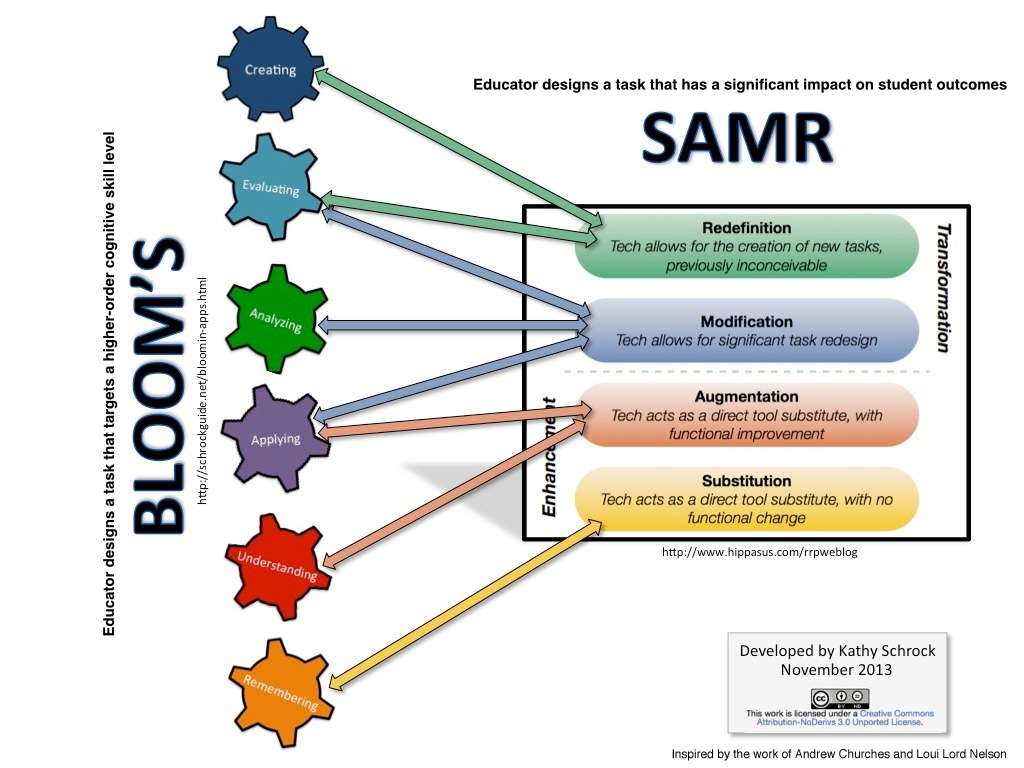
And it wasn't until I had 25 students in front of me with their own iPads that I could really begin to teach using the concept of BYOD. Before I talk about how I use this technology to improve the learning outcomes of my students, I think it is important to put rest to concerns about devices just being used as another fad or a way to engage students. iPads won't engage students any more than Smartboards will, it is still the strategies you use in your teaching that matters. And someone has come up with a lovely acronym to explain just this concept.


This link has some very detailed suggestions on what redefinition might look like in other subjects.

So you can see there is an acknowledgement that tech can be under-utilised if it is just seen as a replacement to pen and paper. At Trident we are finding the SAMR concept encourages us to review what it is we are really assessing at any given point and therefore how flexible the task can be. Sometimes it comes back to practicality and you may have to place limits on students to make your workload manageable. But ultimately, having 1:1 technology in your classroom can open up a whole new world. 


Next time I will write about how I have actually used this tech in my classrooms this year and what I have have learned. It would be great to see your questions below so I can use them to inform what I write about! Have you got a BYOD approach at your school? Do you have any concerns? Have you had any successes?


Whāia te iti kahurangi ki te tūohu koe me he maunga teitei
Pursue excellence – should you stumble, let it be to a lofty mountain